
Company
NHS England
Time
2025–present
(Not released yet)
Role
Interaction/Service Designer
Prototype developer
People usually don't understand how the NHS is organised. Someone may know that they have back pain or need help with a prescription but struggle to find the correct NHS service to get help. This can result in user frustration, delayed care and and wasted NHS resources. All because users haven't been navigated to the right point to get help for their problem in the beginning of their journey.
Generative AI like LLMs could enable a whole new paradigm of patients interacting with NHS services: Instead of asking users to translate their problem into the structure of the NHS services through browsing a website and reasoning about next steps, could the NHS understand what a person has described in their own words to point them to the correct point of care?
The challenge that is unique to healthcare and the NHS: A free-text input interaction needs to be clinically safe, detect emergencies reliably, retain a user's trust and comply to tight regulations for medical devices and privacy.
The challenge that is unique to healthcare and the NHS: A free-text input interaction needs to be clinically safe, detect emergencies reliably, retain a user's trust and comply to tight regulations for medical devices and privacy while simultaneously complying to NHS design and accessibility standards. Keeping these requirements in balance requires close collaboration across design, engineering, clinical safety and governance.

Leading the design of interaction flows and screens, weighing up technical and clinical safety constraints with user needs
Evaluating different AI and deterministic technologies and their implications for design and clinical safety
Development of a live coded prototype of the AI feature using LLM APIs to simulate intelligent routing behaviour
Coordinate between design, development and clinical disciplines to enable safe emergency detection for user input
AI agent design: Evaluating conversational strategies (e.g. Single text entry vs. back-and-forth conversation) and their effect on user behaviour, evaluating different output formats and their effects on user trust
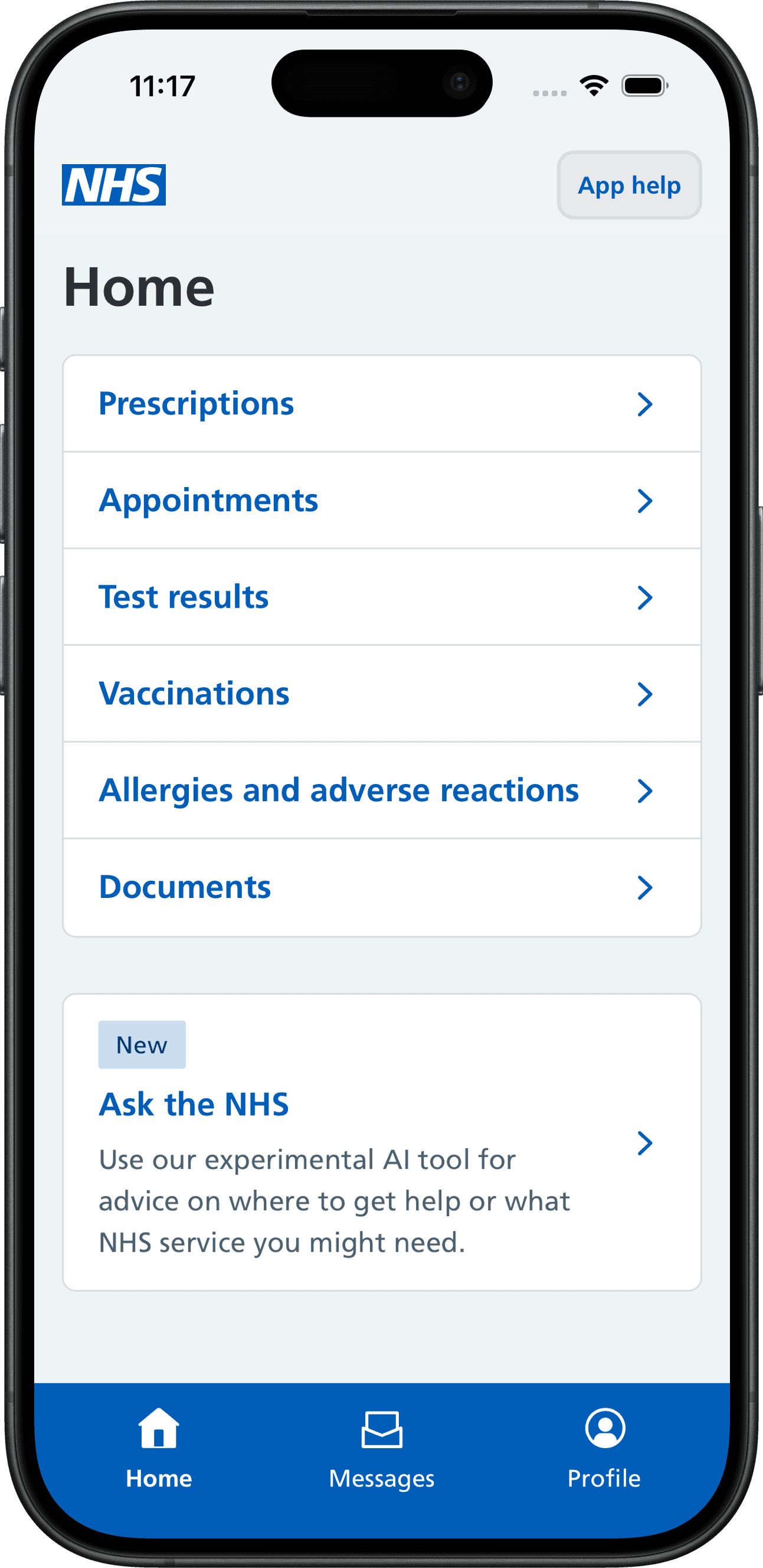
The AI tool will be branded "Ask the NHS" and prominently positioned in the NHS App start page where it can be seen by 41 million registered users.
When selecting the option, the user will be able to specify their intent, i.e. what help they need from the NHS.

A multi-layered AI system with routing logic is queried in real time with the user's intent description.

The tool suggests online or physical NHS services that can help for the specific request, explaining why each recommendation could be helpful.
Making the use of AI transparent
We deliberately “show the seams” of AI: explaining when it is being used, what it can do and where its responsibility ends. The experience also makes clear that it does not access medical records and gives users an alternative to using AI.
Understanding intent, not providing triage
Ask the NHS is designed to understand what someone is trying to achieve and guide them towards an appropriate next step. It does not diagnose, clinically assess or decide what care somebody needs. Potentially urgent concerns are handed over to established NHS services.
Starting with the user's own words
Rather than asking users to understand NHS service categories, we start by letting them describe what they need in their own words. Clarifying questions are only introduced where they help resolve ambiguity — not to create conversation for its own sake.
Recommending without removing choice
The service can recommend a route and explain why it is relevant, while still allowing users to choose another appropriate option. Users who already know what they need should not be forced through unnecessary AI interactions.
Protecting clinically assured content
Clinically assured NHS content should be presented without an LLM rewriting or summarising it. This separates using AI to find relevant information from generating new medical information that has not been clinically assured.
Using agentic coding tools and an off the shelf LLM API, I could quickly create an interactive prototype for demoing and user research purposes. Rather going through a static scenario, users of the prototype can try out how their own. In the absence of an implementation or any production prototypes, the logic that determines which outcomes get presented to users got imitated by an off the shelf LLM given a simple system prompt. The generated structured output from the LLM API would then be rendered in the UI of the prototype.
This prototype enabled us to communicate the concept to senior stakeholders and gave them confidence that the interaction could work in practice, helping secure support to take the project forward into delivery.

Rather than committing to an architecture first, we are defining the behaviours the service needs: what it should understand, when it should clarify, what it should recommend and how it should respond when it cannot help. This means interaction design is helping shape not just the interface, but the underlying requirements for how Ask the NHS will work as a system.
The live prototype I developed used real LLM responses and routing logic, making the experience realistic enough to test the concept end-to-end with users. Research gave us strong evidence that the core interaction works: participants were able to describe what they needed in their own words and understand the recommendations they received, validating free-text intent capture as a viable way of navigating NHS services.
Intent Capture has moved beyond an early AI experiment into the definition of a reusable NHS capability. The current direction is a channel-agnostic service that can understand a person’s goal in natural language, apply explicit safety checks and deterministic routing, and hand them into existing NHS services rather than attempting to triage or diagnose them itself. The first beta release later in 2026 is being shaped around a deliberately limited scope that can be expanded as evidence and confidence grow.
You can stay up to date about this project's progress by reading its regularly updated design history.
Read project design history